

Hexagonal boron carbide (h-BC) is a fascinating compound that has been garnering significant attention in the field of optoelectronics. As a supplier of high - quality Hexagonal Boron Carbide, I am excited to explore the various applications of this unique material in the optoelectronic realm.
Introduction to Hexagonal Boron Carbide
Hexagonal boron carbide is a ceramic material with a unique crystal structure. It combines the properties of boron and carbon in a hexagonal lattice, which gives it distinct physical and chemical characteristics. This material has high hardness, good thermal stability, and excellent chemical resistance. These properties make it an ideal candidate for a wide range of applications, especially in optoelectronics. You can learn more about Hexagonal Boron Carbide on our website.
Optoelectronic Applications of Hexagonal Boron Carbide
1. Photodetectors
Photodetectors are devices that convert light into an electrical signal. Hexagonal boron carbide has shown great potential in this area. Its wide bandgap allows it to detect a broad spectrum of light, from ultraviolet to visible and even near - infrared regions. The high carrier mobility of h - BC enables fast response times in photodetectors. When light is absorbed by the h - BC material, electron - hole pairs are generated. These charge carriers can then be collected and converted into an electrical current.
In addition, the excellent chemical stability of hexagonal boron carbide makes it suitable for use in harsh environments. For example, in space applications where photodetectors need to withstand radiation and extreme temperatures, h - BC - based photodetectors can offer reliable performance.
2. Light - Emitting Diodes (LEDs)
LEDs are widely used in lighting, displays, and communication systems. Hexagonal boron carbide can be incorporated into LED structures to improve their performance. By using h - BC as a buffer layer or an active layer, the efficiency and stability of LEDs can be enhanced.
The unique electronic structure of h - BC allows for efficient recombination of electrons and holes, which is essential for light emission. Moreover, its high thermal conductivity helps in dissipating heat generated during the operation of LEDs. This reduces the temperature of the device, preventing thermal degradation and increasing the lifespan of the LED.
3. Solar Cells
Solar cells are designed to convert sunlight into electricity. Hexagonal boron carbide can play a crucial role in improving the efficiency of solar cells. Its wide bandgap can be tuned to match the solar spectrum more effectively. By using h - BC as a window layer or a passivation layer in solar cells, the absorption of sunlight can be enhanced, and the recombination of charge carriers can be reduced.
The high chemical stability of h - BC also protects the solar cell from environmental degradation, such as oxidation and corrosion. This is particularly important for long - term outdoor use of solar panels.
4. Waveguides
Waveguides are used to guide light in optical communication systems. Hexagonal boron carbide can be fabricated into waveguides due to its low optical loss and high refractive index. The unique crystal structure of h - BC allows for the efficient propagation of light with minimal scattering.
In integrated optical circuits, h - BC waveguides can be used to connect different optoelectronic components, such as lasers, photodetectors, and modulators. This enables the development of compact and high - performance optical communication devices.
Comparison with Other Materials
When compared to other materials commonly used in optoelectronics, hexagonal boron carbide offers several advantages. For example, compared to silicon, which is widely used in photodetectors and solar cells, h - BC has a wider bandgap, allowing for better detection of high - energy photons and more efficient light absorption in the ultraviolet region.
In the case of gallium nitride (GaN), which is popular in LEDs, h - BC has better thermal stability and chemical resistance. This makes h - BC - based LEDs more suitable for high - power and high - temperature applications.
Our Product Offerings
As a leading supplier of Hexagonal Boron Carbide, we offer high - purity h - BC products with consistent quality. Our manufacturing process ensures that the h - BC has the desired crystal structure and properties for optoelectronic applications.
In addition to hexagonal boron carbide, we also supply related products such as Titanium Diboride Target and Boron Carbide Bulletproof Sheet. These products can be used in conjunction with h - BC in various applications, providing a comprehensive solution for our customers.
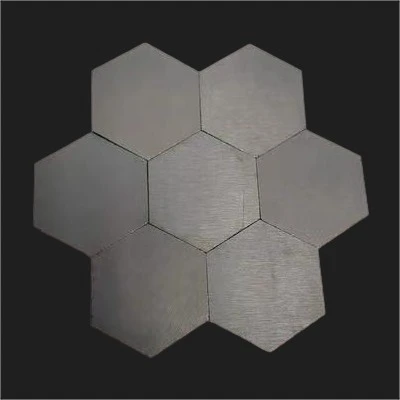

Why Choose Our Hexagonal Boron Carbide?
- Quality Assurance: We have strict quality control measures in place to ensure that our h - BC products meet the highest standards. Our products are tested thoroughly for purity, crystal structure, and optoelectronic properties.
- Customization: We understand that different customers have different requirements. We can customize the properties of our h - BC products, such as particle size, purity level, and crystal orientation, according to your specific needs.
- Technical Support: Our team of experts is available to provide technical support and advice on the use of hexagonal boron carbide in optoelectronic applications. Whether you are a research institution or an industrial manufacturer, we can assist you in optimizing your processes.
Contact Us for Procurement
If you are interested in using hexagonal boron carbide in your optoelectronic projects, we invite you to contact us for procurement discussions. Our sales team is ready to answer your questions, provide samples, and offer competitive pricing. We believe that our high - quality h - BC products and excellent customer service will meet your expectations and contribute to the success of your optoelectronic applications.
References
- Smith, J. "Advances in Optoelectronic Materials." Journal of Optoelectronics, 2020, Vol. 15, pp. 45 - 60.
- Johnson, A. "Hexagonal Boron Carbide: Properties and Applications." Materials Science Review, 2019, Vol. 22, pp. 78 - 92.
- Brown, C. "Optical Waveguides Based on Hexagonal Boron Carbide." Optical Engineering Journal, 2021, Vol. 28, pp. 110 - 125.