

Hey there! As a supplier of Boron Carbide Ceramic Disc, I've been dealing with the manufacturing of these discs for quite a while. One of the most crucial aspects in the production process is ensuring the dimensional accuracy of the Boron Carbide Ceramic Disc. In this blog, I'll share some of the key steps and considerations we take to achieve this.
Understanding the Importance of Dimensional Accuracy
First off, why is dimensional accuracy so important? Well, Boron Carbide Ceramic Discs are used in a wide range of applications, from Boron Carbide Neutron Shielding to industrial machinery. In neutron shielding, even a slight deviation in dimensions can affect the disc's ability to effectively block neutrons. In industrial settings, inaccurate dimensions can lead to poor fit and performance, which might cause the entire system to malfunction. So, getting the dimensions right is a must!
Starting with High - Quality Raw Materials
The journey to accurate dimensions begins with the raw materials. We source high - purity boron carbide powder, which is the building block of our ceramic discs. The quality of the powder affects the density, hardness, and overall structure of the final product. Impurities in the powder can cause uneven shrinkage during the sintering process, leading to dimensional variations. We work closely with our suppliers to ensure that the powder meets our strict quality standards.
Precise Molding
Once we have the right raw materials, the next step is molding. There are several molding methods available, such as dry pressing, isostatic pressing, and injection molding. Each method has its own advantages and is suitable for different production requirements.
For dry pressing, we carefully measure the amount of powder and fill it into the mold cavity. The pressure applied during pressing needs to be uniform across the entire disc to ensure consistent density. Any variation in pressure can result in uneven shrinkage later on. We use advanced hydraulic presses that can precisely control the pressure and ensure a high - quality green body.
Isostatic pressing is another great option, especially for larger or more complex - shaped discs. In this method, the powder is placed in a flexible mold and subjected to uniform pressure from all directions. This helps to achieve a more homogeneous density distribution, which is beneficial for dimensional accuracy.
Sintering: A Critical Step
Sintering is where the magic happens. It's the process of heating the green body to a high temperature to densify the ceramic material. However, sintering is also a stage where dimensional changes occur. The boron carbide powder particles bond together during sintering, and the material shrinks.
To control the shrinkage, we use a well - calibrated sintering furnace. We closely monitor the temperature, heating rate, and holding time. A slow and controlled heating rate is essential to prevent thermal shock, which can cause cracking or uneven shrinkage. We also conduct pre - sintering tests to determine the exact shrinkage rate for each batch of powder. Based on these results, we adjust the dimensions of the mold to compensate for the shrinkage.

Machining and Finishing
After sintering, the ceramic discs may still require some machining to achieve the final desired dimensions. We use diamond - tipped tools for machining because boron carbide is extremely hard. CNC (Computer Numerical Control) machining is our go - to method as it offers high precision and repeatability.
During machining, we carefully program the CNC machine to remove the right amount of material. We measure the dimensions at regular intervals to ensure that we're on track. After machining, we perform a finishing process, such as grinding and polishing, to improve the surface finish and further refine the dimensions.
Quality Control at Every Step
Quality control is an integral part of our manufacturing process. We have a team of experienced quality control technicians who use advanced measuring tools, such as calipers, micrometers, and coordinate measuring machines (CMMs). These tools can measure the dimensions with high accuracy, down to a few micrometers.
We conduct inspections at every stage of production, from the raw materials to the finished product. Any disc that doesn't meet our dimensional specifications is either re - worked or discarded. This strict quality control helps us to maintain a high level of consistency in our products.
The Role of Hexagonal Boron Carbide
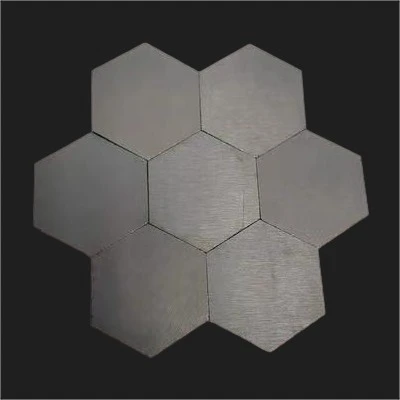
In some cases, we incorporate Hexagonal Boron Carbide into our manufacturing process. Hexagonal boron carbide has unique properties that can improve the mechanical and thermal stability of the ceramic discs. It can also help to reduce the shrinkage during sintering, which is beneficial for dimensional accuracy. We carefully research and optimize the amount of hexagonal boron carbide to add to the powder mixture to achieve the best results.
Continuous Improvement
We're always looking for ways to improve our manufacturing process. We invest in research and development to explore new materials, techniques, and technologies. We also listen to our customers' feedback. If they encounter any issues related to dimensional accuracy, we take it seriously and work on finding solutions.
Conclusion
Ensuring the dimensional accuracy of Boron Carbide Ceramic Discs is a complex but achievable task. It requires a combination of high - quality raw materials, precise molding, careful sintering, accurate machining, and strict quality control. By following these steps and continuously improving our processes, we can produce ceramic discs that meet the most demanding dimensional requirements.
If you're in the market for high - quality Boron Carbide Ceramic Discs with precise dimensions, don't hesitate to get in touch. We're here to discuss your specific needs and provide you with the best solutions. Let's work together to make your projects a success!
References
- "Ceramic Materials: Science and Engineering" by W. D. Kingery, H. K. Bowen, and D. R. Uhlmann
- "Introduction to Ceramics" by Ralph W. Kingery
- Industry reports on boron carbide ceramic manufacturing and applications