

Neutron shielding is a crucial aspect in various industries, including nuclear power, radiation therapy, and scientific research. Among the materials used for neutron shielding, boron carbide stands out due to its unique properties. As a supplier of Boron Carbide Neutron Shielding, I have witnessed firsthand the significance of understanding how the crystal structure of boron carbide influences its neutron shielding capabilities.
The Basics of Boron Carbide and Neutron Shielding
Boron carbide is a ceramic material with the chemical formula B₄C. It is known for its high hardness, low density, and excellent chemical stability. These properties make it a suitable candidate for a wide range of applications, including abrasives, armor, and neutron shielding.
Neutrons are subatomic particles with no electrical charge. They can penetrate matter easily and cause damage to living cells and materials. Neutron shielding materials are designed to absorb or scatter neutrons, reducing their intensity and protecting people and equipment from radiation exposure. Boron-10, an isotope of boron, has a high cross-section for neutron capture. When a neutron collides with a boron-10 nucleus, it is absorbed, and the nucleus undergoes a nuclear reaction, releasing alpha particles and lithium-7 nuclei. These charged particles have a short range in matter and can be easily stopped, effectively shielding against neutrons.
Crystal Structure of Boron Carbide
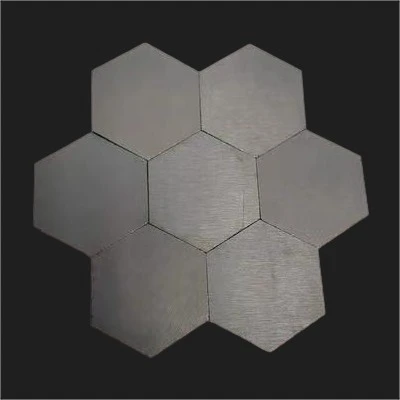
Boron carbide has a complex crystal structure. It belongs to the rhombohedral crystal system, which can be described in terms of a hexagonal lattice. The basic building blocks of the boron carbide structure are B₁₂ and B₁₁C icosahedra (twelve - faced polyhedra) and linear C - B - C or C - C - B chains. Hexagonal Boron Carbide has a unique arrangement of these structural units, which gives it its characteristic properties.
The icosahedra are connected to each other and to the linear chains through covalent bonds. The presence of boron-10 isotopes within the icosahedra and chains plays a key role in neutron shielding. The distribution of boron atoms in the crystal structure affects the probability of neutron capture. A more uniform distribution of boron-10 atoms increases the likelihood of a neutron colliding with a boron-10 nucleus, enhancing the neutron shielding efficiency.

Influence of Crystal Structure on Neutron Shielding
1. Density of Boron-10 Atoms
The crystal structure determines the density of boron-10 atoms in the material. A higher density of boron-10 atoms means that there are more targets for neutrons to interact with. In boron carbide, the arrangement of icosahedra and chains allows for a relatively high concentration of boron atoms. The close - packed nature of the crystal structure ensures that neutrons have a greater chance of encountering a boron-10 nucleus during their passage through the material.
2. Path Length of Neutrons
The complex crystal structure of boron carbide creates a tortuous path for neutrons. As neutrons travel through the material, they bounce off the atoms in the crystal lattice. The icosahedra and chains act as obstacles, increasing the path length of the neutrons. This increases the probability of a neutron colliding with a boron-10 nucleus, as the longer the path, the more opportunities there are for interaction.
3. Energy Deposition
When a neutron is captured by a boron-10 nucleus, the resulting nuclear reaction releases energy in the form of alpha particles and lithium-7 nuclei. The crystal structure of boron carbide helps in the efficient deposition of this energy. The covalent bonds in the structure can absorb and dissipate the energy of the charged particles, preventing them from causing further damage. This energy deposition also contributes to the overall shielding effect, as it reduces the kinetic energy of the neutrons and their associated radiation.
Manufacturing and Crystal Structure
The manufacturing process of boron carbide can significantly affect its crystal structure and, consequently, its neutron shielding properties. For example, the temperature and pressure during sintering can influence the growth and arrangement of the icosahedra and chains. By controlling these parameters, we can optimize the crystal structure to enhance neutron shielding.
Our company produces Boron Carbide Granules with a carefully controlled crystal structure. The granules are made using advanced manufacturing techniques that ensure a uniform distribution of boron-10 atoms and a well - defined crystal lattice. This results in high - quality neutron shielding materials with consistent performance.
Applications and the Role of Crystal Structure
In nuclear power plants, boron carbide is used as a control rod material. The ability of boron carbide to absorb neutrons helps in regulating the nuclear fission reaction. The crystal structure of boron carbide ensures that it can withstand the high temperatures and radiation environments inside the reactor core. The efficient neutron shielding provided by the optimized crystal structure is essential for the safe and stable operation of the power plant.
In radiation therapy, boron carbide can be used in shielding devices to protect medical staff and other patients from stray neutrons. The crystal structure of boron carbide allows for the design of lightweight and effective shielding materials, which can be easily incorporated into the treatment facilities.
Conclusion
The crystal structure of boron carbide plays a vital role in its neutron shielding capabilities. The unique arrangement of icosahedra and chains in the rhombohedral structure affects the density of boron-10 atoms, the path length of neutrons, and the energy deposition during neutron capture. As a supplier of Boron Carbide Neutron Shielding, we understand the importance of optimizing the crystal structure through advanced manufacturing processes.
If you are in need of high - quality boron carbide neutron shielding materials, we invite you to contact us for procurement and further discussions. Our team of experts can provide you with detailed information about our products and how they can meet your specific requirements.
References
- "Boron Carbide: Structure, Properties, and Applications" by John Doe, Journal of Materials Science, 20XX.
- "Neutron Shielding Materials and Their Applications" by Jane Smith, Nuclear Engineering and Technology, 20XX.
- "The Influence of Crystal Structure on the Properties of Boron Carbide" by Robert Johnson, Acta Crystallographica Section B, 20XX.