

Hey there! As a supplier of Boron Carbide Control Rods, I've been in the thick of the nuclear industry for quite some time. And let me tell you, boron carbide control rods play a super crucial role in the refueling process of a nuclear reactor. So, let's dive right in and explore what that role is.
First off, let's talk a bit about nuclear reactors. These things are like the powerhouses of the modern energy world. They generate a ton of electricity by harnessing the energy released from nuclear fission. But here's the catch - nuclear fission is a chain reaction. If it's not properly controlled, things can get out of hand real quick. That's where boron carbide control rods come in.
Boron carbide is an amazing material. It has a high neutron absorption cross - section, which means it's really good at soaking up neutrons. In a nuclear reactor, neutrons are the key players in the fission process. When a uranium atom splits during fission, it releases a bunch of neutrons. These neutrons then go on to split other uranium atoms, creating a chain reaction. If there are too many neutrons flying around, the reaction can become too intense.
The boron carbide control rods are designed to be inserted into the reactor core. When they're inserted deeper, more neutrons are absorbed by the boron carbide. This slows down the chain reaction, reducing the power output of the reactor. Conversely, when the control rods are pulled out, fewer neutrons are absorbed, and the chain reaction speeds up, increasing the power output.
Now, let's get into the refueling process. Refueling a nuclear reactor is a complex and delicate operation. It usually happens every 12 - 18 months, depending on the type of reactor and its operating conditions.
During refueling, the first step is to shut down the reactor. This is done by fully inserting the boron carbide control rods into the core. By absorbing almost all the neutrons, the chain reaction is stopped completely. This is a critical safety measure. You don't want any fission happening while you're trying to remove and replace the fuel rods.

Once the reactor is shut down, the next step is to remove the old, spent fuel rods. These fuel rods have been in the reactor for a long time and have used up a significant amount of their uranium fuel. They're highly radioactive and need to be handled with extreme care. The boron carbide control rods help maintain a stable environment during this process. They keep the neutron flux low, ensuring that there's no unexpected resurgence of the fission reaction.
After the old fuel rods are removed, new fuel rods are inserted into the core. This is where the control rods are adjusted again. They're carefully positioned to ensure that the new fuel starts a controlled fission reaction. The operators need to find the right balance. If the control rods are pulled out too quickly, the reaction can become too intense. If they're not pulled out enough, the reactor might not reach its desired power level.
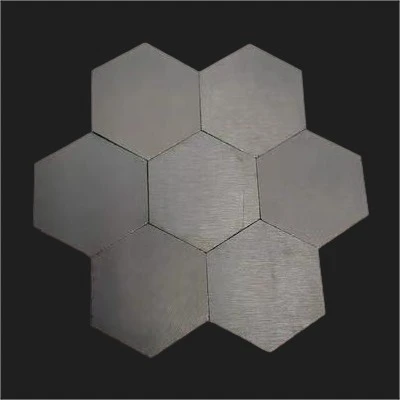
Let's talk a bit about the different types of boron carbide products we offer. We have Hexagonal Boron Carbide, which has unique crystal structures that can enhance its neutron - absorbing properties. It's a great option for control rods where high - performance neutron absorption is required.
Another product is the Boron Carbide Ceramic Disc. These discs are used in some reactor designs where a flat, compact neutron - absorbing element is needed. They're highly durable and can withstand the harsh conditions inside a nuclear reactor.
We also supply Titanium Diboride Target. Although not strictly a control rod material, titanium diboride is used in some related applications in the nuclear industry. It has good thermal and electrical conductivity, which can be useful in certain reactor components.
The quality of the boron carbide control rods is of utmost importance. We use advanced manufacturing techniques to ensure that our control rods meet the highest standards. We test them rigorously for their neutron - absorbing capabilities, mechanical strength, and resistance to corrosion. After all, these control rods are the safety valves of the nuclear reactor.
One of the challenges in the refueling process is dealing with the radioactive environment. The boron carbide control rods themselves become radioactive over time due to neutron activation. This means that when they're removed from the reactor for maintenance or replacement, special handling procedures are required. We've developed methods to minimize the radiation exposure during these operations.
In addition to safety, efficiency is also a key factor. The design of the boron carbide control rods can affect how quickly the reactor can be refueled. For example, if the control rods can be inserted and removed more smoothly, it can reduce the downtime of the reactor. This is important because every day the reactor is offline means lost electricity production.
As a supplier, we're constantly working on improving our products. We're researching new materials and manufacturing processes to make our boron carbide control rods even better. We're also collaborating with reactor operators to understand their specific needs and challenges during the refueling process.
If you're in the nuclear industry and are looking for high - quality boron carbide control rods, we'd love to talk to you. Whether you're involved in reactor design, operation, or maintenance, we can provide you with the right products and solutions. Our team of experts is always ready to assist you in choosing the best boron carbide products for your specific requirements.
In conclusion, boron carbide control rods are indispensable in the refueling process of a nuclear reactor. They ensure the safety and efficiency of the entire operation. From shutting down the reactor to starting it up again after refueling, these control rods play a vital role at every step. So, if you're in the market for boron carbide control rods or related products, don't hesitate to get in touch. We're here to help you keep your nuclear reactor running smoothly.
References
- Nuclear Reactor Engineering: Reactor Systems Engineering, Fourth Edition, by Arthur E. Bell, Samuel Glasstone
- Fundamentals of Nuclear Reactor Physics, by J. K. Shultis and R. E. Faw